July 19, 2026
Research Supervisor Search Tool for a Funded PhD (2026)
What Applyindex, ChatGPT, and Google Scholar solve for finding a supervisor, the funding-specific gap they leave open, and why search and cold email need to run together.
Most guides to finding a research supervisor, including the most comprehensive ones, are written for a general question: "who studies what I'm interested in?" That's a fine starting point, but if you're specifically trying to fund a PhD or Masters, it's the wrong question. The one that actually matters is narrower: who's studying what I'm interested in and currently has the funding and lab space to take someone on. A search tool that ignores that distinction hands you a list that looks useful and mostly isn't.
What a research supervisor search tool should actually do for a funded applicant
Three things, in order: surface professors whose recent work genuinely overlaps with your interests, give you a real signal on whether they're still active (not retired, not on long-term leave, not buried under a faculty list from three years ago), and get you to their actual, current contact details. Most platforms do the first part well and the other two poorly, which is exactly where a promising-looking list quietly turns into hours of dead ends.
The 6 traditional methods, and the funding gap in each one
- University department websites. Authoritative, but static: a page updated once a year won't tell you a professor lost their grant renewal last month.
- Web of Science / Google Scholar. Excellent for confirming someone is actively publishing in your exact niche. Neither tells you anything about their current funding situation or whether their lab has room.
- LinkedIn. Useful for confirming someone still works where you think they do. Reaching out here instead of by email reads as less professional in most departments and is easy to miss.
- ResearchGate. Good for a paper trail, similarly silent on funding or capacity.
- ChatGPT. Useful for generating search terms and adjacent sub-fields you might not have thought of. It can't browse a professor's live record, confirm a working email address, or know whether they're still at the institution it "remembers."
Every one of these methods can tell you a professor exists and works in your area. None of them (including the search platforms built on top of them) can tell you they're fundable right now. That single gap is the entire reason volume and personalised outreach matter more than finding one perfect match.
How to actually check "still active" yourself, in under 5 minutes
Whichever method or tool surfaces a name, run this before you invest an email:
- Check their most recent publication date. Within the last 1-2 years is a good sign; nothing since 2022-2023 often means they've moved on, retired, or gone on extended leave.
- Look for a "not accepting students" note on their homepage or a recent department announcement.
- Check the department's current faculty listing, not just a cached search result: professors do leave institutions without every directory catching up immediately.
- Search their name plus the current year to catch a recent move, retirement announcement, or grant award you'd otherwise miss.
None of this confirms funding (nothing can), but it filters out the professors who were never reachable in the first place, which is most of what "wasted" outreach actually is.
Google Scholar: exact search strings worth copying
Google Scholar remains one of the most reliable free sources precisely because it indexes actual recent papers, not a directory that might be stale. A few searches worth running directly:
[your sub-field] [specific method or technique]: narrower than your general field, surfaces the professors actually working on your exact angle.[your sub-field] since:2024using Scholar's date filter: restricts results to people publishing recently, which doubles as an activity check.site:[university].edu [your sub-field]: useful once you have a shortlist of target universities and want to see who there is publishing in your area.
Where GradScoutFunding actually differs from Applyindex
Applyindex is a genuinely comprehensive platform: it matches professors to your profile using its own CV-scoring system, estimates admission chances for funded PhD positions, and will draft and send outreach emails automatically on your behalf. That last part is a real, specific design choice, not a gap: full automation suits someone who wants the process handled end-to-end.
GradScoutFunding makes the opposite choice on purpose. It finds professors filtered by field, country, and institution type, confirms they're actively publishing (not that they're funded, see above), and uses AI alignment scoring to match your actual profile against that specific professor's research. Then it drafts the personalised email and hands it to you to review and send yourself: nothing goes out under your name that you haven't read first. Credits are one-time and never expire, rather than a recurring membership.
Neither approach is objectively better. If you want full hands-off automation, that's a real thing Applyindex offers. If you want the research and the writing done for you but the final send to stay entirely in your control, that's what GradScoutFunding is built around.
| GradScoutFunding | Applyindex | |
|---|---|---|
| Sends the email | Drafts it: you review and send | Sends it automatically on your behalf |
| Profile scoring | AI alignment score vs. that specific professor's research | Proprietary "a-index" university/admission-chance ranking |
| Funding verification | Confirms active publishing only: no tool can verify funding directly | Estimates admission chances; funding availability itself still unverifiable |
| Pricing | One-time credit packs from $5, credits never expire | Membership package (3 users per package); full pricing not public |
A list of names still isn't an outreach campaign
Popular professors get somewhere between 100 and 200 cold emails a month and decide whether to reply in about four seconds. A perfectly matched name from any search tool doesn't change that filter: the email still has to prove you read their actual work, not just found their profile. One widely-shared account describes sending over 360 personalised emails, doing about 20 interviews, and landing 3 funded offers. That's a volume-and-personalisation story, not a talent story, and the search tool alone only ever gets you halfway there.
How to actually run this
- Start with 20-30 names in one field and country: enough to run a real campaign without drowning in half-researched leads.
- Confirm activity before you write anything: a paper from the last 1-2 years is a far better signal than a department page that hasn't been touched since 2022.
- Write or generate an email specific to each one: the same note sent to five professors in one department is easy to spot and easy to delete.
- Follow up after 2-3 weeks of silence: most eventual replies come from the follow-up, not the first email.
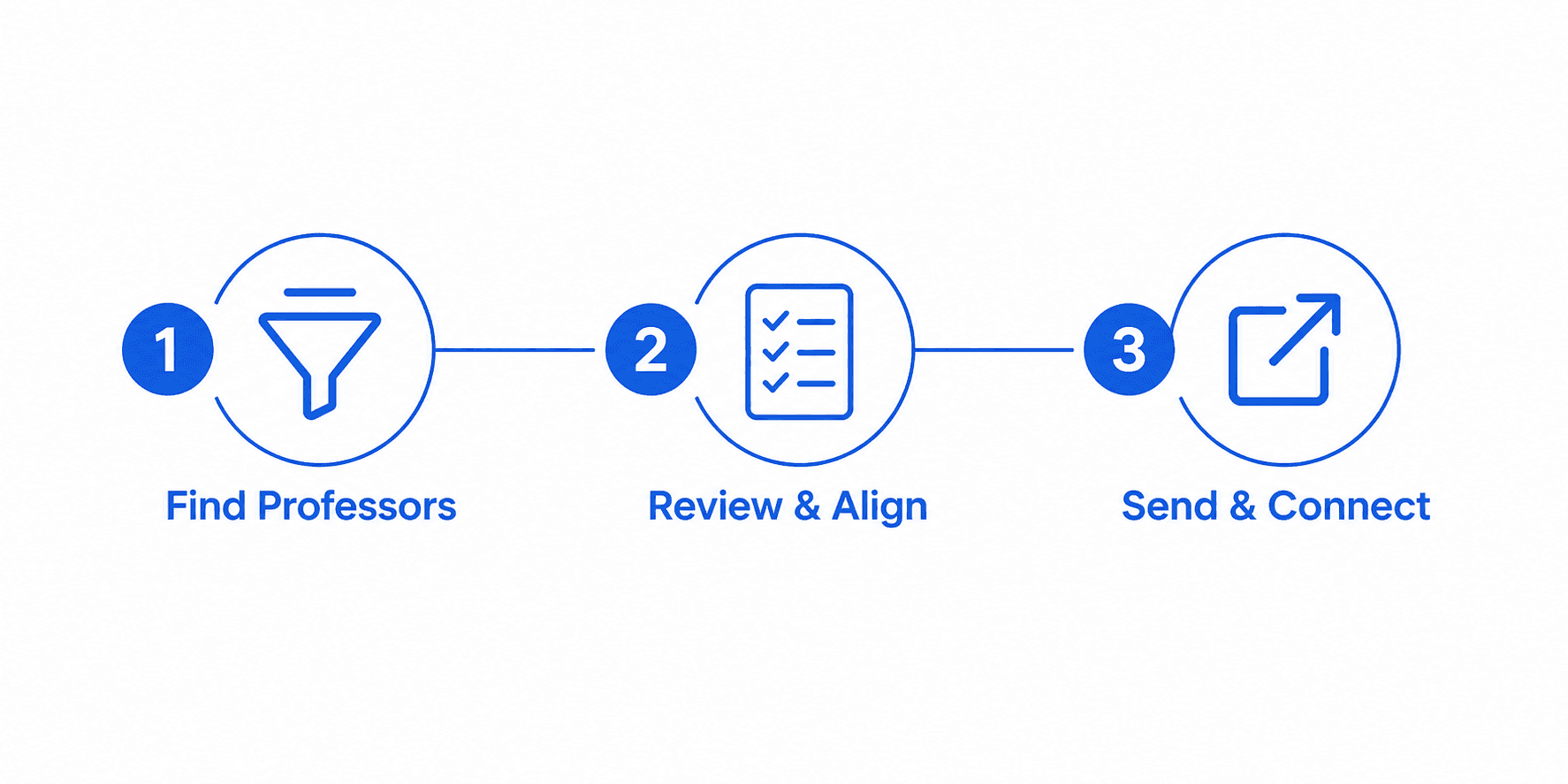
If you already have a research direction, GradScoutFunding runs the first three steps in one place (filtered search, activity check, and a grounded email draft for you to review), free for your first 2 credits (one professor match, one generated email), no card required. Try the professor search tool yourself.
Common questions
Is a research supervisor search tool the same thing as a cold email tool?
No, and treating them as the same is the most common mistake. A search tool answers "who should I contact?" A cold email tool answers "what do I actually say to them?" Most tools, including the biggest matching platforms, only solve the first question and leave the second entirely to you.
Can any tool verify a professor actually has funding available?
No: not this one, not Applyindex, not any directory. Publication activity, lab openings, and grant status can be checked; live funding availability for a specific professor in a specific term generally can't be verified from outside. That's exactly why volume and personalisation matter more than finding one "guaranteed" match.
Is ChatGPT good enough to find a research supervisor on its own?
It's useful for brainstorming search terms and sub-fields, but it can't browse a professor's live publication record, confirm a current email address, or tell you if they're still at the same institution. Treat it as a starting point for search terms, not a source of verified names.
What's the real difference between GradScoutFunding and Applyindex?
Applyindex auto-sends outreach emails on your behalf and includes a CV-based university ranking system. GradScoutFunding drafts the personalised email and hands it to you to review and send yourself, and its alignment scoring is matched to the specific professor's research rather than a general university ranking. Neither approach is objectively better: it depends whether you want full automation or to stay in control of what goes out under your name.
How many professors should a search tool actually surface before I start emailing?
20-30 for a focused search in one field and country is a reasonable starting list: enough to run a real outreach campaign without drowning in half-researched names.
Related reading
- Google Scholar vs. ResearchGate for Finding a PhD Supervisor (2026)
- Best Tools to Find Professors for PhD (2026)
- How to Email a Professor for PhD Funding
- How to Find a Professor's Email for Masters Funding
- How to Get a Professor Contact List for PhD Applications (2026)
- Cheapest Way to Find a PhD Supervisor (2026)
Stop writing these one at a time.
GradScoutFunding finds the professors, researches their actual papers, and writes the personalised email above: for a hundred professors, not one. Your first 2 credits are free.
Find my first professor, free