July 13, 2026
How to Email a Professor for PhD Funding
The exact structure that gets replies: what to say, what to leave out, and why the first email should never ask for money.
Popular professors get somewhere between 100 and 200 cold emails a month. They can't reply to most of them, so they filter, in about four seconds, for one thing: does this email prove the person actually read my work, or is it another copy-paste asking for money?
That four-second filter is the entire game. Not your CGPA. Not your CV. The email. The good news: the base rate for this kind of email is far better than the "cold email" label suggests, see the real data on how often professors reply , which is exactly why the structure below is worth getting right.
Two things before you start: you need to know who to target, using research supervisor search tools to find people whose work actually overlaps with yours, and you need their actual inbox, which usually means finding professor email addresses directly rather than guessing. GradScoutFunding's find professor tool does both at once, filtered by field and country.
The structure that actually gets replies
Strip away the advice blogs disagree on, and the same five rules show up in every account from students who actually got funded:
- Keep it short. Five to eight sentences. The professor is reading this on their phone between meetings.
- Mention their specific paper. Not their field in general: a specific recent paper, and one sentence on why it connects to what you want to work on. See how to actually read the paper first in 10 minutes, not a full afternoon.
- Attach a clean CV. Nothing elaborate. One page, no typos, easy to skim, see the right format for a cold-email CV specifically, it's a different document from your formal application CV.
- Don't ask for funding in the first email. This is the mistake that kills more emails than any other, covered in more detail below.
- Follow up after 2–3 weeks if you hear nothing. Most of the eventual yeses come from the follow-up, not the first email.
Why you should never ask for funding first
Almost every experienced applicant says the same thing: the first email's job is to open a conversation about research fit, not to ask "do you have funding for me?" A professor who gets a funding question in the first line reads it as "another international student who just wants money" and deletes it. A professor who gets a sharp, specific note about their actual research reads it as "a potential colleague."
Funding almost always comes up naturally once a professor is interested. In most graduate funding systems, US assistantships especially, the scholarship follows the professor, not a portal. Your job in email one is to make one professor want you on their team. The money follows.
So when is it actually okay to ask? Usually the second or third exchange: once they've responded with genuine interest, asked a follow-up question, or suggested a call. At that point, a direct "Is there a funded position available, or should I apply for external funding separately?" reads as a reasonable practical question from someone they're already considering, not an opening demand from a stranger.
The 5 mistakes that get your email deleted immediately
Physics professor Jan Lagerwall posted the exact email he'd just deleted, publicly, as a warning to applicants. It read:
"I have been following your research with great interest, particularly your work in your research area and your recent publications. I am impressed by the quality and impact of your research, and I believe your laboratory would provide an excellent environment to further develop my research skills and contribute to meaningful scientific discoveries."
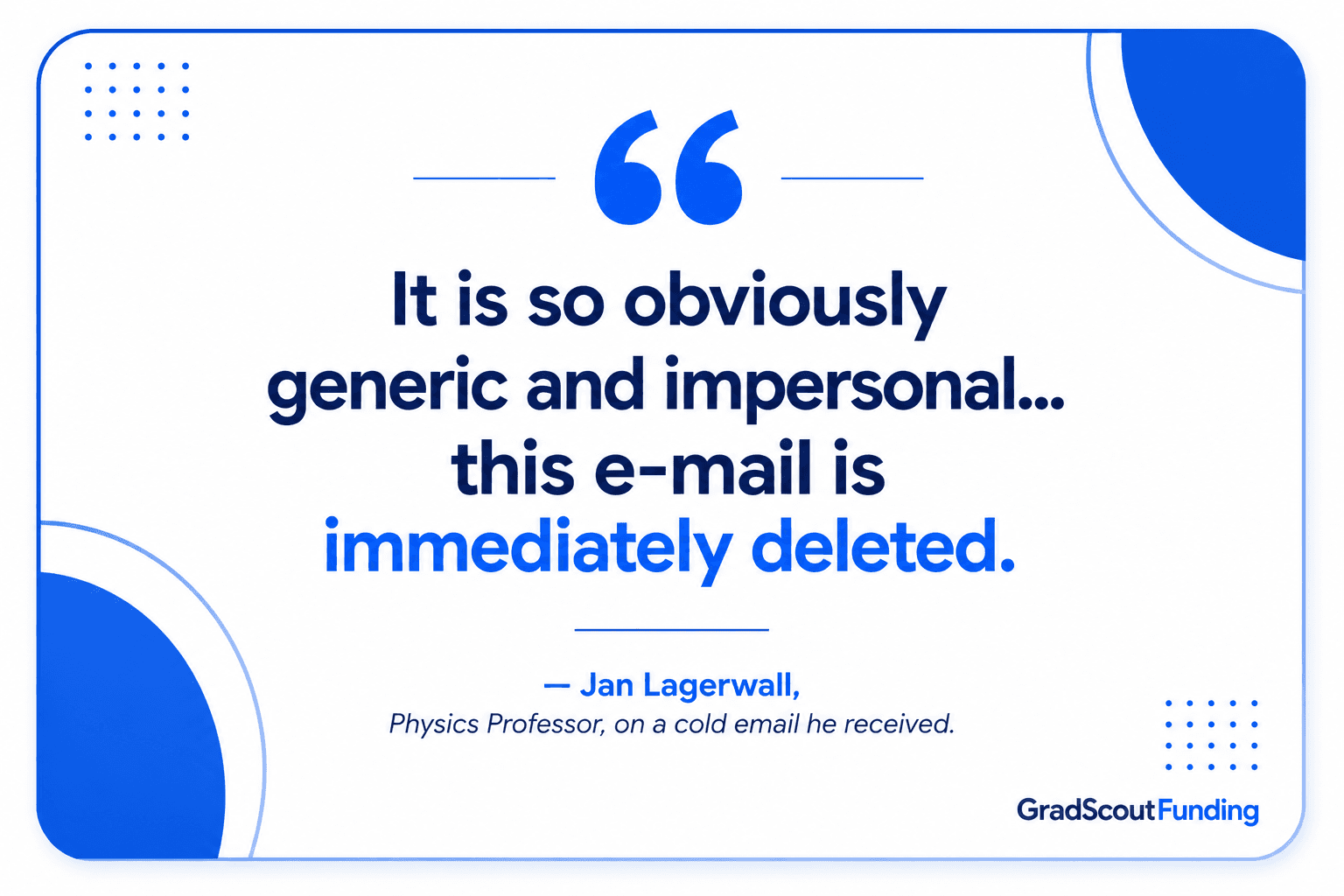
His response, verbatim: "It is so obviously generic and impersonal... if they were [interested], they would have been able to specify the research area as well as some key outputs from our research. So this e-mail is immediately deleted." That one paragraph contains three of the five mistakes below at once.
- "Your research area" instead of an actual topic. Professors don't want "I love your research area." They want "I read your 2024 paper on X and have a question about Figure 3." Vague praise is the single most obvious tell that an email is mass-sent, because it's the one line that could be copy-pasted into any inbox in the department without changing a word. The fix isn't finding a fancier way to say "interested": it's replacing the whole sentence with a specific detail from a paper only that professor wrote.
- Asking for funding before proving fit. A professor who gets a funding question in line one reads it as "another applicant who just wants money," not a colleague. This is the single most common mistake in every guide reviewed for this post, and the one every experienced applicant specifically warns against: funding is the outcome of a professor deciding they want you, not the opening line of the conversation that gets them there. This is a sequencing problem, not a reason to avoid the funding question entirely, see is it rude to email professors for funding if the worry is stopping you from asking at all.
- Writing five paragraphs to a reader who has four seconds. Length reads as disrespect for their time, not effort. A professor skimming 150 emails a month isn't going to read a life story; they're scanning for one thing: does this person understand my actual work? Five to eight sentences that answer that clearly beat three paragraphs that circle around it.
- The same email sent to fifty professors with the name swapped. Professors compare notes, and generic AI phrasing ("I am writing to express my profound interest") is now instantly recognisable and deleted on sight. The irony is that AI tools were supposed to make outreach faster, but a generic AI draft applied to 50 professors is functionally identical to the hand-written mail-merge template it replaced: same problem, just typed faster.
- No CV attached, or a CV that doesn't match the email's claims. If you claim relevant experience, the CV needs to back it up in the first glance, not bury it on page two. A one-page CV that's easy to skim in ten seconds does more work here than a three-page document listing every course you've ever taken.
What gets a reply instead
"Hi Professor [Name], I just read your 2025 paper on [specific finding]. The part about [specific detail] connects directly to a final-year project I did on [related topic]. I'm applying for a funded PhD starting Fall 2027 and wanted to ask: are you currently taking new students whose interests overlap with that direction? I've attached a one-page CV. Happy to share more detail on the project if useful."
Short. Specific. Proves the paper was actually read. No funding ask. Low-effort for the professor to answer: it's basically a yes/no question.
Should you attach your CV, or wait until they ask for it?
This is one of the few places where genuinely experienced advice-givers disagree with each other, and neither side is wrong exactly: they're guarding against different failure modes.
The case for attaching: a professor who's interested but not quite curious enough to reply "send me your CV" is someone you can lose to a second, avoidable step. If the CV is one page and skimmable in ten seconds, it costs almost nothing to glance at.
The case against: some applicants who tracked what actually worked for them landed on the opposite rule, never attaching unless it was specifically requested, on the reasoning that an unsolicited attachment reads as slightly presumptuous in an inbox that's already filtering hundreds of emails a year. That camp offers the CV instead: "happy to send my CV if useful," turning it into a small back-and-forth rather than assuming the professor wants it.
The real dividing line isn't attach-versus-never-attach: it's volume. A single one-page PDF costs a reader nothing to open, on a phone or otherwise, which is why the professor quoted earlier in this post deleted an email over vague, copy-pasted phrasing, not because something was attached to it. Where the against-camp has an actual point is when applicants send a CV plus transcripts, writing samples, and a thesis PDF all in the first message. That's the version that reads as presumptuous, not the CV itself. Default to one page, one attachment, mentioned in a single clause, and either approach works.
5 email templates by field
The structure below works across fields (Subject, Greeting, Who You Are, Why You're Reaching Out, Closing + CV, Signature), but the specifics inside each paragraph should sound like your field, not a generic essay. Five examples:
Computer Science / Machine Learning
Subject: Prospective PhD Student Interested in [Specific Subfield, e.g. Robust Model Evaluation]
Dear Professor [Last Name], I'm a final-year Computer Science graduate applying for a funded PhD starting Fall 2027. I read your 2025 paper on [specific paper title] and found the approach to [specific technical detail] especially relevant to a project I built on [related topic, mention a GitHub repo or benchmark if you have one]. I'd welcome the chance to discuss whether my background overlaps with your current lab's direction. My CV is attached. Happy to share code or a project writeup if useful.
Sincerely, [Your Name]
Biology / Life Sciences
Subject: Prospective PhD Student Interested in [Specific Organism/Mechanism/Pathway]
Dear Professor [Last Name], I'm a final-year [Biology/Biochemistry] graduate applying for a funded PhD starting Fall 2027. Your 2025 paper on [specific finding] connects directly to a final-year project I ran on [related mechanism/method], and I'd be glad to share the details if that's useful. I wanted to ask whether you're currently taking new students whose interests overlap with that direction. CV attached: it includes any relevant lab/wet-lab experience.
Sincerely, [Your Name]
Humanities / Social Sciences
Subject: Prospective PhD Student Interested in [Specific Theme/Case Study]
Dear Professor [Last Name], I'm a final-year [Discipline] graduate applying for a funded PhD starting Fall 2027. I read your recent work on [specific argument or case study] and it directly shaped a research question I'd like to pursue: [one-sentence proposed thesis direction]. I'd welcome the chance to discuss whether this fits your current research programme. CV attached, and I'm happy to share a longer research proposal if that would help.
Sincerely, [Your Name]
Engineering / Physical Sciences
Subject: Prospective PhD Student Interested in [Specific System/Material/Process]
Dear Professor [Last Name], I'm a final-year [Engineering/Physics] graduate applying for a funded PhD starting Fall 2027. Your 2025 paper on [specific system or process] connects directly to a final-year design/research project I completed on [related topic], and I'd welcome the chance to discuss whether my background overlaps with your lab's current direction. I'm particularly interested in [one specific technical question about their method or results]. CV attached, including relevant lab/simulation/fabrication experience.
Sincerely, [Your Name]
Economics / Business / Quantitative Social Science
Subject: Prospective PhD Student Interested in [Specific Model/Dataset/Policy Question]
Dear Professor [Last Name], I'm a final-year [Economics/Business] graduate applying for a funded PhD starting Fall 2027. I read your recent paper using [specific method or dataset] to study [specific question], and it directly shaped a research question I'd like to pursue: [one-sentence proposed direction]. I'd welcome the chance to discuss whether this fits your current research programme. CV attached, including any relevant quantitative/research assistant experience.
Sincerely, [Your Name]
The follow-up email template (this is where most yeses come from)
If you don't hear back, follow up in 1-2 weeks. Still nothing? Follow up once more, 1-2 weeks after that. Still silent after the second follow-up? Move on. Academics are busy; don't take it personally.
Subject: Re: [Original Subject Line]
Dear Professor [Last Name], I wanted to briefly follow up on my email from [date] about potential PhD supervision. I understand you're busy, so no pressure at all. I just wanted to check whether you're currently able to take new students. Happy to resend my CV or share more detail if useful.
Thank you again for your time, [Your Name]
How many professors do you actually need to email?
More than feels reasonable. One widely-shared account: a student sent over 360 personalised emails, did about 20 interviews, and was accepted by three professors. That's the real funnel: hundreds of emails in, a handful of offers out. The students who make it out aren't smarter than everyone else stuck refreshing scholarship portals. They emailed more of the right professors, and they didn't stop after the first silence.
Most people quit around email 12. The ones who get funded usually don't hit their first yes until somewhere past email 60. Spread over a realistic pace, that's not as extreme as it sounds: 5-8 genuinely personalised emails a week over 2-3 months gets you to 60-100 without the burnout that comes from trying to write them all in one exhausted weekend.
What to do when a professor actually replies
None of the guides reviewed for this post cover this part, and it matters: the moment you get a reply, the game changes from "get noticed" to "don't waste the opening." See what to do when a professor responds positively for the full breakdown by reply type, or the summary below.
- "I don't have funding this cycle, but happy to chat." Take the call. A professor without funding today can still become an advocate, point you to a colleague who does have funding, or remember you next cycle. Politely declining because there's no money yet is one of the most common ways people accidentally close a door that was still opening.
- "Can you tell me more about your background?" This is not a rejection: it's an invitation to send the detail your first email deliberately left out. Answer directly, keep it just as specific as the first email, and resist the urge to over-explain.
- A request for a call. Prepare the same way you would for a real interview: reread their recent papers, have 2-3 specific questions about their current work ready, and be ready to talk about your own project in plain language, not just jargon.
- Silence after an initially warm reply. This still happens: professors get pulled into deadlines and travel. One more polite follow-up after 2 weeks is normal, not desperate. See how to follow up with a professor after no reply for the full timing and template.
When to send it
Timing changes reply rates more than people expect. Late summer / early fall is when most professors are planning next year's intake and actually reading email. December, when departments are drowning in applications, is the worst time to introduce yourself cold. And never assume a same-day reply. Professors are not checking email at 3am your time. Mapping this against your actual application deadlines on a funding timeline makes it much harder to accidentally start outreach too late.
If English isn't your first language, or you're writing from outside the US/UK
None of the major guides on this topic address this directly, but it's a real, common worry for international applicants: will a professor read British spelling, a more formal tone, or occasional imperfect phrasing as a sign you can't communicate? In practice, professors reviewing international applicants are used to a wide range of English styles, and a slightly formal or non-American phrasing is not what gets an email deleted: vagueness and length are. A short, specific, grammatically clean email in British English will always beat a long, generic one in perfect American English. Time zones, visa logistics, and country-specific funding norms add more to plan around than tone alone. See how to email professors as an international student for the full breakdown.
If you're worried about phrasing, run your draft through a grammar checker before sending, but don't let a tool rewrite your voice into something generic: the goal is a clean version of how you'd actually write, not a flattened, AI-smoothed paragraph that reads like everyone else's. And if your country's naming conventions differ from Western norms, it's fine to clarify your preferred name/title once in the signature rather than over-explaining it in the body.
How to personalise 20 emails in 10 minutes, not 20 hours
Writing one great, specific, research-grounded email takes real time: reading the paper, finding the genuine overlap, writing it so it doesn't sound like the Jan Lagerwall example above. Most people can manage maybe four a day before burning out. At that rate, a list of 150 professors is over a month of daily grind, and life doesn't pause for that.
This is exactly the gap GradScoutFunding exists to close: it finds professors who are actively publishing (the strongest available signal they're still working and likely still taking students, though no tool can verify funding availability itself), reads their actual recent papers, and writes the personalised email above, at the volume the funded ones actually send, without the burnout, and without ever producing the generic paragraph that gets deleted on sight. Run this in parallel with named scholarships you're eligible for, and once a professor replies, get ready for what usually comes next with the interview prep tool.
Quick reference: before you hit send
- Specific paper mentioned, not just their general field
- No funding question in the first email
- Five to eight sentences, not five paragraphs
- One-page CV attached and consistent with what you claimed
- Subject line specific to the topic, not generic, see real subject line examples by field and situation
- Follow-up scheduled for 1-2 weeks out if you hear nothing
- A second follow-up scheduled for 1-2 weeks after that, then move on
Common questions
Should I email a professor before or after applying?
Before, in most systems, especially US PhD programmes where funding flows through a specific professor's grant. Emailing after you've already applied means you're asking someone to retroactively justify a decision the admissions committee will make anyway, rather than building the relationship that gets you funded in the first place.
What if the professor's lab website looks outdated?
Check their most recent publications directly (Google Scholar is more reliable than a lab page that hasn't been updated in years) before assuming they're inactive. A quiet website doesn't always mean a quiet lab: some of the busiest researchers have the least time to maintain a site.
Is it okay to email more than one professor at the same university?
Yes, but be upfront about it if it comes up, and avoid emailing two professors in the exact same small lab group within days of each other. Different departments or clearly distinct research groups at the same university are completely normal to approach in parallel.
What should I do while waiting for professors to reply?
Keep applying: a professor's yes isn't the same as an admission, and the two processes usually run in parallel. Track deadlines on a timeline, and use any wait time to prepare for the possibility of an interview if someone does reply.
Do scholarships still matter if I get a professor to say yes?
Some do: a few named scholarships specifically require an existing supervisor lined up before you apply, so a professor's yes can unlock scholarship eligibility rather than compete with it. Check the funding page for scholarships you're eligible for once you have a research fit confirmed.
Should I attach my CV to the first email, or wait until they ask for it?
Both approaches work, and experienced applicants are genuinely split. The safer default is a single one-page CV, attached, mentioned in one short clause. The advice against attaching is really advice against sending several documents at once (CV, transcripts, writing samples); one page on its own doesn't create the clutter that camp is worried about.
Is it worth emailing a professor's current PhD students too?
Yes, once you've made contact with the professor or while you're waiting to hear back. Current students in the lab are often more candid than a professor would be about day-to-day supervision style, and they can sometimes tell you about internal fellowships or the actual stipend amount that never made it onto a public funding page.
Related reading
- How to Email a Professor Whose Lab Website Is Outdated (2026)
- How to Find a PhD Supervisor in Sweden (and Get Funded)
- How to Email a Humanities Professor vs. a STEM Professor (2026)
- Do Professors Mind Cold Emails From International Students? (2026)
- ChatGPT vs. Personalized Cold Emails to Professors (2026)
- Is It Rude to Email Professors for Funding? (2026)
- How to Email Multiple Professors in the Same Department Without Looking Spammy (2026)
- How to Email a Professor You Met at a Conference (2026)
- First Author vs. Corresponding Author: Who to Actually Email (2026)
- How Nigerian Students Can Email US Professors (2026)
- Cold Emailing vs. Applying Directly for a PhD (2026)
- Best Tools to Find Professors for PhD (2026)
- Best Way to Get a Funded PhD Without a Scholarship
- Research Supervisor Search Tool for a Funded PhD (2026)
- PhD Interview Questions and Answers (2026)
- How to Find a Professor's Email for Masters Funding
- How to Write a Research Statement for a PhD Cold Email (2026)
- How to Get a Professor Contact List for PhD Applications (2026)
- Difference Between RA, TA, and GA Funding Explained (2026)
- How to Find Professors Accepting Graduate Students (2026)
- How to Find a PhD Supervisor in Canada (and Get Funded)
- How to Find a PhD Supervisor in the UK (and Get Funded)
- What to Do When a Professor Responds Positively to Your Email (2026)
- Do Professors Actually Reply to Cold Emails? (2026 Data)
- PhD Cold Email Subject Line Examples (2026)
- How to Email Professors as an International Student (2026)
- Fully Funded PhD in Germany for Nigerians (2026)
- Why Cold Emails Get Marked as Spam (2026)
- Dr. vs. Professor: Which Title to Use When Emailing (2026)
- PhD Funding for Refugees and Displaced Students (2026)
- PhD Funding for Entrepreneurs and Founders (2026)
- How to Find a PhD Supervisor in Portugal (and Get Funded)
- Funded PhD in Saudi Arabia for International Students (2026)
Stop writing these one at a time.
GradScoutFunding finds the professors, researches their actual papers, and writes the personalised email above: for a hundred professors, not one. Your first 100 credits are free.
Find my first professor, free