August 4, 2026
How to Find a PhD Supervisor in Germany (and Get Funded)
Individual vs. structured doctorate explained, the real databases and DAAD-adjacent funding to search, and why cold-emailing still matters even in Germany's institutional system.
Germany runs a genuinely different PhD system from the US or UK, and most guides either explain the structure (individual vs. structured doctorate, the database names) or explain cold-emailing, rarely both, and rarely how they connect. They connect directly: which path you're on determines who actually controls your funding decision, and that changes how you should be spending your time.
Individual doctorate vs. structured PhD programme
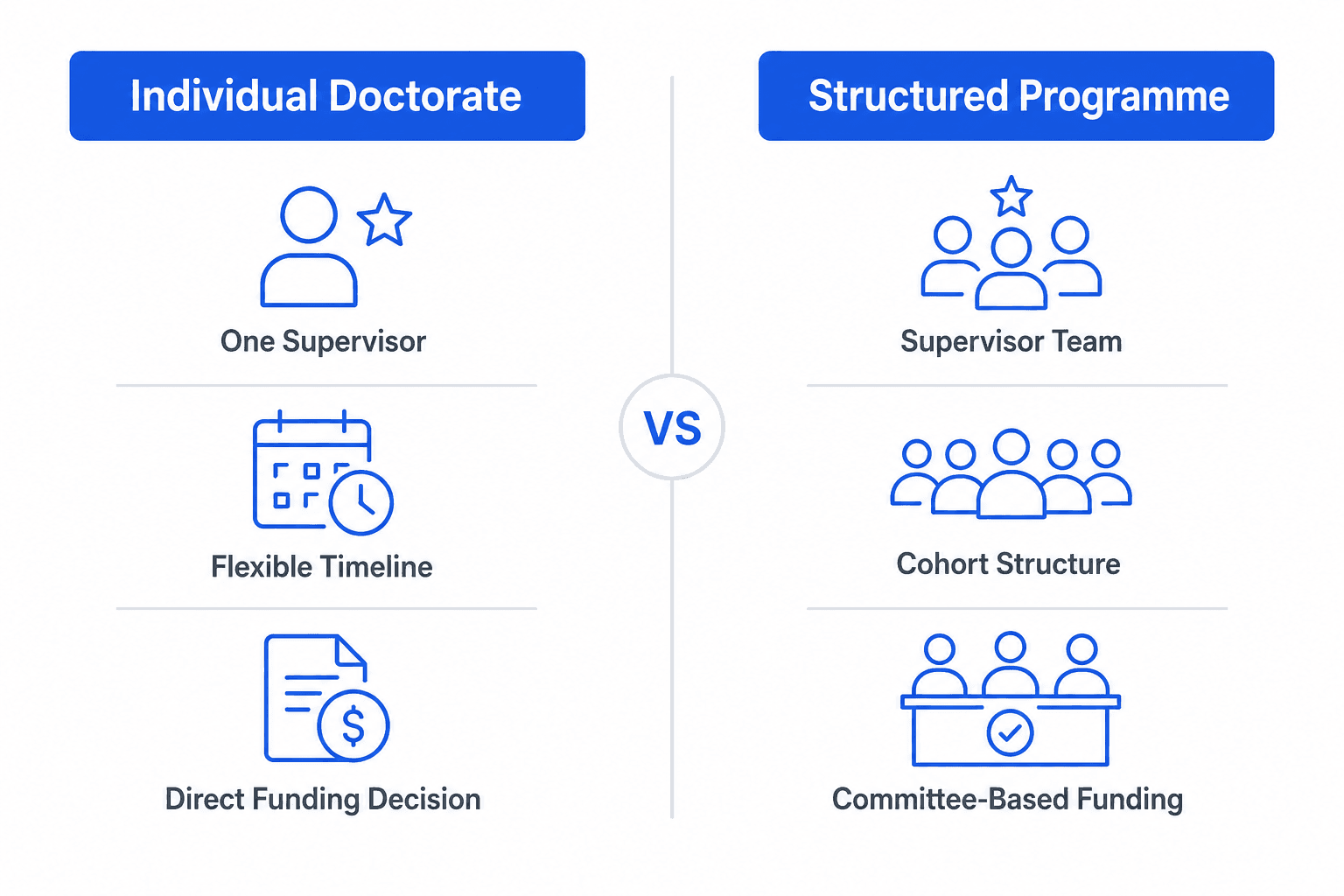
- Individual doctorate (the traditional route). You find one professor willing to supervise you, and your dissertation is produced under their direct guidance. More flexible, demands more personal initiative, and the professor's decision to take you on is, in practice, the funding decision too, since it's usually their own grant money.
- Structured PhD programme. Closer to US/UK-style PhD programmes: a team of supervisors oversees a cohort of doctoral students, with more built-in structure, coursework, and milestones. Funding here typically runs through the programme's own budget or grant, decided by an admissions committee rather than one person alone.
How this maps to who actually controls your funding
This is the connection most Germany-specific guides never make: the individual-vs-structured split is the German version of the RA-vs-TA-vs-GA distinction that determines funding elsewhere. An individual doctorate is professor-controlled, the same dynamic as an RA or GRA position: one person's interest in your fit is the deciding factor, and it doesn't require a formal committee process. A structured programme is closer to a TA/GA route: institution-run, decided by committee, with a defined application cycle rather than an open-ended conversation. If you're specifically trying to secure funding through a direct relationship with one professor, the individual doctorate route is where that actually happens. For a hybrid model that splits admission and supervisor assignment into two separate formal steps instead, see how a PhD supervisor search works in Turkey.
The real databases worth searching
- Higher Education Compass. Search by department across roughly 870 faculties that accept English-language dissertations.
- GERiT. A directory of around 32,000 research institutions in Germany, searchable by location or subject area, useful for finding labs a general search would miss.
- PhDGermany. A portal specifically publishing PhD openings aimed at international applicants.
- DAAD's own database. Roughly 230 structured international programmes, alongside DAAD's general scholarship search.
These are genuinely useful for structured programmes and for identifying departments to target. For an individual doctorate specifically, they're a starting point, not the whole search: the actual next step is finding the specific professor within that department whose current research fits yours, which is where cold email comes back in.
DAAD scholarships and other funded routes
Beyond direct professor funding, Germany has several real, funded structured routes worth knowing by name: DFG-funded Research Training Groups (some running up to nine years), Helmholtz Graduate Schools, Leibniz Graduate Schools, and International Max Planck Research Schools. These typically fund a cohort at once through a structured programme rather than one professor's individual grant. Worth applying to in parallel with direct professor outreach, not instead of it, since the two run on different timelines and decision processes.
Employment contract or scholarship? The distinction most guides skip
Most guides to funding a German PhD, including database listings and DFG-funding overviews, talk about "funding" as one thing. It isn't. In Germany, doctoral funding comes in two legally distinct forms, and which one you get changes your tax situation, your insurance, and even your future pension, not just your monthly income.
- An employment contract (a "Stelle"). The most common way individual doctorates and many DFG-funded positions are actually paid: you're hired as a wissenschaftlicher Mitarbeiter (research associate) on the public-sector TV-L pay scale, grade E13, the grade for work requiring a completed university degree. DFG guidance recommends funding doctoral positions at a minimum of 65% of a full E13 post rather than 100%, deliberately, so the contracted hours leave room for the actual thesis work alongside project duties. A full, 100% E13 post runs roughly in the €4,700-6,800 gross-per-month range under the pay tables in effect from April 2026, depending on experience step, a 65% post is paid at that same fraction, and the exact figures are revised periodically, so confirm the current table before comparing numbers. Because it's an employment contract and not a grant, you get a normal payslip and pay into German pension and unemployment insurance, and that time counts toward your state pension later.
- A scholarship (a "Stipendium"). What DAAD and similar programmes typically pay: a fixed, usually tax-free monthly stipend rather than a salary. You're not legally an employee of the university, so that period doesn't count toward German pension insurance, and you're usually responsible for arranging your own health insurance rather than having it split with an employer.
The practical takeaway: when a professor or programme says they "have funding," ask directly whether it's a Stelle or a Stipendium. Both are real funding, but they're not financially interchangeable, and most Germany PhD guides never make the distinction explicit enough to act on.
Why cold-emailing still matters, even in Germany's institutional system
It's easy to read Germany's database-heavy, institutional search process and assume email outreach matters less here than in the US. For an individual doctorate specifically, it matters just as much, since that professor's agreement to supervise you is the actual gate, not a formal application form. Popular professors get 100-200 cold emails a month regardless of country and decide whether to reply in about four seconds, the same filter covered in how to email a professor for PhD funding applies here without modification. GradScoutFunding finds professors filtered by field and country (including Germany specifically), confirms they're actively publishing, and drafts a personalised email grounded in their real work, for you to review and send, no consultation call required. Try the professor search tool free, your first 100 credits cost nothing.
What changes about the email itself
The core structure, specific paper reference, short, no funding question in the first line, stays the same as anywhere else. Two things worth adjusting for Germany specifically:
- Titles matter more formally. Address a professor with a doctorate as "Prof. Dr. [Last Name]" if you know they hold both titles, rather than just "Professor." It reads as attentive rather than stiff, German academic correspondence leans more formal than US norms by default.
- English is fine, but say so isn't needed. Most professors in internationally-active labs read and reply in English without issue. Writing a stilted email in imperfect German to seem respectful usually reads worse than a clear, well-written English one.
Common mistakes specific to Germany's system
- Assuming an individual doctorate means you don't need to email anyone. It's the opposite: without a structured programme's admissions process, the email to one professor is the entire application.
- Not clarifying which route you're asking about. A professor may supervise both individual doctoral candidates and structured-programme students; being explicit about which one you're asking about avoids a confusing first exchange.
- Applying for DAAD funding before confirming a supervisor. Many DAAD and other scholarships require a named, confirmed supervisor as part of the application itself, not something you line up afterward.
- Treating the databases as a substitute for reading the professor's actual recent work. Higher Education Compass and GERiT are good for finding names; they don't replace reading a paper before you email.
A realistic timeline
- 12+ months before: identify target departments via the databases above, and start reading recent papers to find specific professors, not just departments.
- 9-12 months before: begin direct outreach to professors for an individual doctorate, and start structured-programme applications, which often run on their own fixed cycle.
- 6-9 months before: apply for DAAD or other external scholarships once you have a confirmed or likely supervisor, many require this before you apply, not after.
- Ongoing: follow up on professor outreach independently of the scholarship cycle, since it doesn't share the same fixed deadlines.
Common questions
Is it better to do an individual doctorate or a structured PhD programme in Germany?
Depends on what you want. An individual doctorate gives more flexibility and puts funding directly in one professor's hands, closer to the RA-style route common in the US. A structured programme gives more built-in support and cohort structure but runs through an admissions committee, closer to a TA/GA-style process. Neither is objectively better, they suit different working styles and risk tolerances.
Do I need to speak German to do a PhD in Germany?
Usually not for the PhD itself, especially in STEM fields where research and publishing happen in English and many professors run English-speaking labs. Day-to-day life outside the university is easier with at least basic German, and some structured programmes list English proficiency as sufficient without a German language requirement.
How much does a DAAD scholarship actually pay?
Historically in the range of roughly €1,200-1,400 a month for doctoral candidates, plus health insurance and travel allowances, though exact figures change and should always be confirmed on DAAD's current published rates before you rely on a specific number.
Can I email a professor in Germany before I've been formally admitted?
Yes, and for an individual doctorate this is effectively required, since the professor's agreement to supervise you is usually the actual funding decision, separate from any formal university application step.
What if a German professor says they have no funding right now?
Ask whether they'd support a DAAD or other external scholarship application with you as the named supervisor, this is common in Germany specifically, since many scholarships require a confirmed supervisor before you apply, not after.
What's the difference between a PhD "Stelle" and a PhD "Stipendium" in Germany?
A Stelle is an employment contract, usually a wissenschaftlicher Mitarbeiter (research associate) position paid on the TV-L E13 pay scale, which means a normal payslip, tax withholding, and contributions to German pension and unemployment insurance. A Stipendium, like most DAAD funding, is a fixed monthly stipend that's usually tax-free but isn't employment, so it doesn't count toward German pension insurance and typically leaves you to arrange your own health insurance. Ask a professor or programme which one is actually on the table before comparing offers by monthly amount alone.
Why are German PhD positions often advertised at 65%, not full-time?
It's deliberate, not a red flag. DFG guidance recommends funding doctoral positions at a minimum of 65% of a full E13 post specifically so the contracted hours leave real time for the dissertation itself, on top of whatever project or teaching duties the position involves, rather than treating the PhD as unpaid overflow work on top of a full-time job.
Related reading
- How to Find a PhD Supervisor in Sweden (and Get Funded)
- How to Find a PhD Supervisor in the Netherlands (and Get Funded)
- How to Find a PhD Supervisor in Norway (and Get Funded)
- How to Find a PhD Supervisor in the USA (and Get Funded)
- How to Find a PhD Supervisor in Belgium (and Get Funded)
- Difference Between RA, TA, and GA Funding Explained (2026)
- How to Email a Professor for PhD Funding
- DAAD Application Process Explained Step by Step (2026)
- How to Write an Erasmus Mundus Motivation Letter (2026)
- How to Get a Scholarship to Study Abroad for a Masters or PhD (2026)
- How to Find a PhD Supervisor in Canada (and Get Funded)
- How to Find a PhD Supervisor in the UK (and Get Funded)
- Fully Funded PhD in Germany for Nigerians (2026)
- How to Find a PhD Supervisor in Turkey (and Get Funded)
- How to Find a PhD Supervisor in Spain (and Get Funded)
Stop writing these one at a time.
GradScoutFunding finds the professors, researches their actual papers, and writes the personalised email above: for a hundred professors, not one. Your first 100 credits are free.
Find my first professor, free